PASOS - Revista de Turismo y Patrimonio Cultural: Vol. 22, Núm. 3 (2024)

- https://ojsull.webs.ull.es/index.php/Revista/issue/view/108
PASOS - Revista de Turismo y Patrimonio Cultural: Vol. 22, Núm. 3 (2024)
- https://ojsull.webs.ull.es/index.php/Revista/issue/view/108
Abstract
This research aims to analyse business operators’ perception of the impact of the Portuguese Way of St. James and to assess the landscape situation along a total section of 115 kilometres. Perceptions were collected in a survey of 112 small operators between 2020 and 2021. The diversity and singular components of the landscape make it a pleasant route to experience, where pilgrims have the possibility to improve wellbeing, and enjoy the landscape. Operators have profited from the significant increase in the number of pilgrims walking along the Way and claim that they aim to continue their operations.
Paula C. Remoaldo
Eduardo Duque
Vítor Ribeiro
José Cadima Ribeiro
Hélder Silva Lopes
Sandro Ferreira
Cátia Faria
(Resumo de texto publicado em International Journal of Religious Tourism and Pilgrimage, Vol. 12. N. 1, págs. 112-129, junho de 2024 -https://arrow.tudublin.ie/ijrtp/vol12/iss1/9/)
Abstract
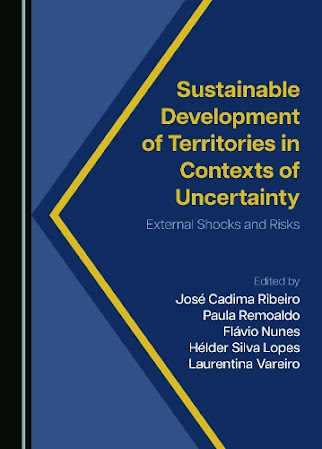
The pursuit of development has increasingly prioritized sustainability. Sustainable approaches to development and adopting people’s well-being as a main goal have substantial implications for the competitiveness of territories. When viewed through a nature lens, sustainability maintains a close connection with circular economy. If sustainability is the paradigm the world needs to commit to, businesses, policy makers and people have to deal with the difficulties and uncertainties arising from those requirements and other severe phenomena, like international armed conflicts and pandemic crises. By using case studies, this book addresses territorial bottlenecks and grapples with social and developmental challenges. The book intends to function as a practical guide for policymakers and practitioners, providing them with the knowledge necessary to adopt and implement sustainable development strategies. It advocates the implementation of socially inclusive policies and the adoption of innovative governance models able to safeguard democratic principles while enhancing the efficacy of decision-making processes.
Edited by
José Cadima Ribeiro, Paula Remoaldo, Flávio Nunes, Hélder Silva Lopes, and Laurentina Vareiro
TABLE OF CONTENTS
Introduction
José Cadima Ribeiro, Paula Remoaldo, Flávio Nunes, Hélder Silva Lopes, Laurentina Vareiro
Chapter 1
Regional
Tourism Planning: bibliometric review and analysis
Daniela Meneses, Carlos Costa, Fernanda A. Ferreira, Celeste Eusébio
Chapter 2
Regional
Development: sustainability and rurality in the south of Minas Gerais (Brazil)
Carlos Alberto Máximo Pimenta, Jaqueline Viana de Paiva, Gabriel José Dias Ferreira, Jeniffer de Nadae
Chapter 3
The
Development of Municipalities in the Metropolitan Region of Paraíba Valley and
North Coast of São Paulo (Brazil): fiscal sustainability versus social
sustainability
Maxwel Gouveia Simpliciano, Edson Trajano Vieira, Moacir José dos Santos
Chapter 4
Social
Entrepreneurship and Local Development: the case of the MediCar project
Fernando Teixeira, Susana Pescada, Ivone Marques
Chapter 5
Attracting
Digital Nomads to Rural Areas: an attempt to bridge the demographic gap
Rodolpho Tsvetcoff, Rui Patrício, Sofia Alçada
Chapter 6
Gastronomy
of Lambayeque and its Contribution to Regional Development in Peru
Rosse Marie Esparza-Huamanchumo, María del Pilar Miranda-Guerra, María de la Cruz del Rio-Rama, José Álvarez-García
Chapter 7
Use of GIS
for the Delimitation of Renewable Electricity Potential Coverage in the Territories
of Andalusia (Spain): synergies and opportunities toward the energy transition
Lucas da Silva Almeida, Jesús Molina Belmonte, Bárbara Montero González
Chapter 8
Business
Incubators in Low-Density Territories: the case of the municipality of Ferreira
do Alentejo (Portugal)
Fernando Teixeira, Susana Pescada, Claúdia Oliveira
Chapter 9
Pilgrimage,
landscape and human senses across the Portuguese St. James Way
Paula Remoaldo, Eduardo Duque, Vítor Ribeiro, José Cadima
Ribeiro, Sandro Ferreira
- https://www.cambridgescholars.com/product/978-1-0364-0337-9
Abstract
The pursuit of development has increasingly prioritized sustainability. Sustainable approaches to development and adopting people’s well-being as a main goal have substantial implications for the competitiveness of territories. When viewed through a nature lens, sustainability maintains a close connection with circular economy. If sustainability is the paradigm the world needs to commit to, businesses, policy makers and people have to deal with the difficulties and uncertainties arising from those requirements and other severe phenomena, like international armed conflicts and pandemic crises. By using case studies, this book addresses territorial bottlenecks and grapples with social and developmental challenges. The book intends to function as a practical guide for policymakers and practitioners, providing them with the knowledge necessary to adopt and implement sustainable development strategies. It advocates the implementation of socially inclusive policies and the adoption of innovative governance models able to safeguard democratic principles while enhancing the efficacy of decision-making processes.
(Abstract of book to be published soon by Cambridge Scholars Publishing, Edited by
José Cadima Ribeiro, Paula Remoaldo, Flávio Nunes, Hélder Tiago Lopes, and Laurentina Vareiro)
Bibliometric analysis of the research on St. James Way performed for the period 1997-2023
Leida Costa, Paula Remoaldo, Hélder Lopes, José Cadima Ribeiro, Vítor Ribeiro e Rafaela Silva
Abstract
The aim of this paper is to perform a bibliometric analysis of publications related to the St. James Way indexed in the Scopus database in the period 1997-2023. This is the first time that this kind of study is done concerning this period of 26 years. 139 studies and several variables were taken into consideration, such as, the type and year of publication, subjects approached, methods, techniques used, and country of publication. It was noted that the amount of the studies related to the St. James Way is reduced, and that the first study indexed in Scopus database dates back to 1997. The data collected in the Scopus database was analyzed using the VOsviewer tool. This tool allowed the generation of a set of thematic network maps using analysis of keyword occurrences, documents and countries with the highest number of publications, journals with the highest number of publications and most productive authors. It was found that there is a relationship between the keywords inserted in the database, that is, there are authors who, when approaching the Way, used three to four common keywords ("pilgrims", "tourism", "religion", and " St. James Way"). The subject of St. James Way attracts research from many scientific areas, such as Economy, Arts and Humanities, Social Sciences, Law and Environmental Sciences. Since 2011, the number of publications indexed in Scopus increased a lot, but it was since 2019 that the number increased in a more substantial way, along with the diffusion and interest in this religious and cultural route. Between 1997 and 2015, the studies had a more general nature, with descriptive stories about the Camino, and its evolution since the medieval age. Since 2016, the number of empirical studies has been increasing. This study can contribute to the evolution of research on religious tourism and pilgrimage, especially the one concerning the St. James Way routes.
Keywords: Bibliometric
Study; Scopus Database; Camino de Santiago; St. James Way; VOSviewer.
[Não esteve bem nem mal; foi o que se conseguiu com muito trabalho e dedicação]


It is a pleasure to inform you that the issue n. 67 (January 2024) of our journal (Revista Portuguesa de Estudos Regionais / Portuguese Review of Regional Studies) is now online. You can accede to the issue using the following link:
https://review-rper.com/index.php/rper/issue/view/67
Thank you for
contributing to the success of the journal. We will go on counting on you!
I wish you all a
successful year 2024!
Best regards,
J. Cadima Ribeiro

Sustainability in Tourist Destinations: A Multidimensional Approach
Laurentina Vareiro
UNIAG, Lab2PT and Polytechnic University of Cávado and Ave (IPCA),Barcelos,
Portugal, lvareiro@ipca.pt (corresponding
convener)
Paula Remoaldo
Lab2PT and Institute of Social Sciences, University of Minho, Braga, Portugal, cris.remoaldo@gmail.com
José Cadima Ribeiro
NIPE and Lab2PT,
University of Minho, Braga, Portugal, jcadima@eeg.uminho.pt
Abstract
This
session seeks to scrutinize the various dimensions of sustainability in tourist
destinations. By dissecting the eco-footprint of accommodation, investigating
the provenance of culinary resources, and assessing the ecological impacts of
entertainment activities, we aim to analyse the multiple dimensions involved (a holistic approach) in destinations
sustainability. The discourse will extend to encompass the integration of
environmental preservation, community involvement and economic viability. This
session aims to provide new insights on the issue, exploring innovative
methodologies to maintain the allure of tourist destinations while ensuring
their enduring ecological and societal well-being.
Your
contribution is pivotal to advancing on the discourse on responsible and
sustainable tourism practices. Theoretical and empirical backgrounds are accepted. The main
research areas of this Special Session are the following topics:
1. Conceptualization of Comprehensive Sustainability in Tourist Destinations.
2.
Bibliometric Analysis of Sustainable
Practices in Tourism Activities.
3.
Best Practices on Environmental,
Social and Economic Sustainability in the Tourism Industry.
4.
Best Practices for Attaining Destination
Sustainability.
5.
Sustainable Practices in
Accommodation and/or Food Provision.
6.
Engaging Residents in the Promotion
of Sustainable Destinations.
7.
Engaging Politicians in the Promotion
of Sustainable Destinations.
8.
Political Difficulties in
Implementing Destinations Sustainability.
9.
Sociocultural Difficulties in
Implementing Destinations Sustainability.
10. Quantitative
Methods in the Analysis of Sustainable Practices in Tourism.
11. Qualitative
Methods in the Analysis of Sustainable Practices in Tourism.
12. New
Approaches to Tourism Sustainable Practices.
13. The
Future of Destinations Sustainability.

Abstract
This research seeks to investigate the factors influencing residents’ perceptions and attitudes towards tourism, focusing on the interaction between destination’s residents and tourists. A survey applied to residents of the Azores archipelago (Portugal) in 2018 received 451 answers. The findings follow the assumptions of the Social Exchange Theory, namely, respondents that used to keep closer contact with tourists and/or directly benefited from the tourism industry tended to express stronger support for the industry’s development. Regional and national authorities must be aware of these results when designing their policies, namely in the pursuit of a sustainable development strategy for the Azores.
Keywords: Residents’ perceptions; social exchange theory; positive and negative perceptions towards tourism; personal economic benefits; Azores Islands (Portugal).
José Cadima Ribeiro
Laurentina Vareiro
Isabel Cristina Monjardino
[“Residents’ attitudes toward tourism development in the Azores, Portugal: effects of tourist-to-resident interaction”, in Handbook on Tourism Planning, Philip Feifan Xie (Ed.), Edward Elgar Publisher, Northampton, Massachussetts, 2023, cap. 13, pp. 225-241; https://doi.org/10.4337/9781803923598.00019]

Special Session (S12)
Special Session Title
“Looking to Tourism Industry as a Potential Contributor to the Development of Protected Areas: Approaching it from the Demand and the Supply Sides”
José Cadima Ribeiro
NIPE and School of Economics and Management, University of Minho, Braga, Portugal, jcadima@eeg.uminho.pt (corresponding convener)
Luís Filipe Silva
NIPE, University of Minho, Braga,
Portugal, luissilvamkt@gmail.com
Abstract
The growing interest in visiting Protected Areas (Pas)
has transformed these areas in important and popular nature-based tourism
destinations. However, increased public visits can significantly impact those
areas and turn harder their management. These impacts may affect these areas in
different ways, given that some PAs have great notoriety and have established
successful sustainable tourism models, while others are absent from the tourist
market and in many cases are underfunded, poorly managed, and ecologically
damaged.
Motivation can be seen as a driving force that impel individuals to act, which is produced by a state of tension resulting from unfulfilled needs and is at the basis of the decision-making process. Motivations are considered a key concept in the study of visitors’ behaviour, as they are behind all actions. Besides, it is well known that individuals respond differently to stimuli and engage in tourism activities for different reasons and purposes. Thus, motivation and tourists profile analyses are critical to generate better experiences while ensuring PAs sustainability.
By another side, community engagement and support are also essential elements for ensuring the long-term success of sustainable tourism development, environmental conservation, and the overall sustainability and development of territories. From both short and long-term perspectives, for destinations to achieve success and sustainability, the tourism industry must generate economic and social benefits for local residents without endangering the communities’ social and cultural heritage or the quality of the destination’s natural environment. Consequently, the sustainability and competitiveness of tourism destinations depend significantly on their ability to improve the well-being of stakeholders, including residents, while preserving endogenous resources.
Potential topics to approach in this special
section are:
•
Protected areas visitors` motivations and profiles;
• Community support and long-term success of
tourism development,
environmental
conservation and overall sustainability of protected areas;
• Environmental, economic, and social impacts of
tourism on protected areas destinations;
• New
governance models for PAs;
•
Visitors’ satisfaction and loyalty towards protected areas;
• The
role of non-massified tourism products in PAs tourist development;
•
Climate change and sustainable destinations;
• Conceptual
approaches to more sustainable forms of tourism.

Abstract
Visitor satisfaction and loyalty are critical for the sustainability of protected areas (PAs). However, there is a substantial knowledge gap regarding the dynamic influences of motivation and perceived quality on these variables. To address this gap, this study examines the complex relationships between visitor motivations and the perceived quality of PA attributes, and their role as contributors to satisfaction and loyalty. A survey was conducted among visitors of a Portuguese PA, yielding 316 questionnaires. The results from the PLS-SEM model indicate that only nature and relaxation motivation directly affects satisfaction. Motivations can have different effects on the perceived quality of various PA attributes, and these attributes mediate the motivation-satisfaction relationship to different degrees. Satisfaction was found to mediate the quality-loyalty relationship. These findings contribute to the underdeveloped body of knowledge regarding the antecedents of satisfaction and loyalty in PAs, while providing substantial management implications for the park under analysis.
Luís Filipe Silva
J. Cadima Ribeiro
Francisco Carballo Cruz
[Resumo de artigo disponível em Leisure Sciences - An Interdisciplinary Journal, publicado online em 2023/11/27 (https://doi.org/10.1080/01490400.2023.2285348)]

Meus senhores,
Minhas senhoras,
Caros(as) amigos(as),
1. As
derradeiras décadas do século XX e as primeiras do século XXI, até à crise
sanitária da COVID-19, foram marcadas pela aceleração da globalização, nas suas
distintas materializações (trocas de bens e serviços, movimentos de capitais,
movimentos de turistas, mobilidade do trabalho, entre outras).
Um resultado porventura inesperado desse
movimento foi a atenção que certos recursos e dinâmicas locais passaram a
merecer da parte das autoridades públicas, incluindo a Comissão Europeia.
No caso particular da União Europeia, foram
estabelecidos programas financeiros destinados a combater a acentuação das
assimetrias entre regiões, e os Estados-membros foram encorajados a materializar
políticas de descentralização.
Deve entender-se como descentralização a
devolução pelos governos nacionais de funções específicas, a governos regionais
e locais autónomos, com todas as atribuições administrativas, políticas e
económicos que essa transferência de competências implica.
2. Falando
de descentralização, em geral, esta ocorreu em praticamente todo o mundo.
Pelo menos na intenção, muitos dos processos
de descentralização visaram reformar o modelo de governo dos países,
substituindo lógicas hierárquicas e burocráticas de gestão de cima para baixo
por sistemas de autogoverno caraterizados pela participação, cooperação e
transparência na prestação de contas.
É neste contexto que se fala de
descentralização como um processo de devolução de poder aos cidadãos.
No caso de Portugal, um dado que chama
particularmente a atenção, (comparativamente com os demais países do Ocidente
Europeu) é a ausência de um nível intermédio entre o governo central e os
governos locais (Municípios e Freguesias), excluídas as regiões autónomas dos
Açores e da Madeira.
Acresce que o aumento das competências e
responsabilidades que foi sendo atribuído aos municípios, no contexto de processos
de descentralização que foram sendo implementados, nem sempre foi acompanhado
pelo conveniente reforço de autonomia de decisão, de capacitação institucional
e de recursos financeiros que lhes permitissem fazer face às exigências daí
decorrentes.
3. Tal
como nos processos de descentralização, em geral, há duas dimensões que são
centrais em qualquer processo de regionalização.
A primeira é a da devolução do poder aos
cidadãos, isto é, aproximar o poder dos cidadãos e criar contexto para uma
melhor perceção por parte dos atores políticos das realidades dos territórios.
Dessa proximidade há-de resultar a capacidade
de melhor olhar para os recursos e capacidades, e desenhar políticas, e pode
conseguir-se também um nível mais elevado de mobilização dos atores e das
comunidades para o ataque aos problemas.
A segunda dimensão é a do desenvolvimento, na
medida em que se perceba os territórios e os seus agentes como sede primeira de
recursos, capacidades e iniciativas que ditarão a afirmação económica de
lugares e regiões.
É por estas razões que Mozzicafreddo (em 2003)
entendia que um processo de descentralização era, também, uma peça essencial de
modernização politica, social e institucional, e um instrumento de
desenvolvimento regional e de mobilização social e territorial.
Estas dimensões não são, de facto,
problemáticas disjuntas na própria medida em que dificilmente há iniciativa e,
sobretudo, projeto económico e social sem liderança e sem algum nível de
institucionalização.
Os processos de descentralização e de
regionalização supõem a existência de atores que possam ser o sujeito e o
objeto da devolução de poder, e protagonistas das estratégias de desenvolvimento
dos territórios.
4. O
antecedente mais remoto do livro aqui apresentado, com o título “Regionalização
e Descentralização em Portugal”, foi a participação que tive num Debate sobre a
temática “Descentralizar ou Transferir? Defender o Poder Local Democrático”,
organizado em Lisboa, a 17 de novembro de 2018.
A organização
do evento prendeu-se com a implementação da Lei nº 50/2018, que estabeleceu a
transferência, gradual, de um conjunto alargado de competências para as
“autarquias locais” e as “entidades intermunicipais”, e prendeu-se, igualmente,
com as sequelas daí derivadas.
Na
intervenção que então fiz sublinhei que a escolha das entidades sobre as quais
incidia o essencial do processo de descentralização que se pretendeu
concretizar ao abrigo da Lei nº 50/2018, os Municípios, e, complementarmente, as
Comunidades Intermunicipais, apresentava uma dificuldade inultrapassável, que
era a ausência de estrutura intermédia, isto é, regional.
No
contexto da dita Lei, percebe-se que tenha sido atribuído às comunidades
intermunicipais o papel de coordenação, planeamento e gestão de recursos
necessário.
Em
todo o caso, em muitas situações, essa escala oferece-se inadequada
(subdimensionada), para além da entidade em causa ser desprovida de
legitimidade política direta, e, daí, estar dependente da capacidade de
concertação interna dos municípios participantes, o que nem sempre é garantido,
também.
5. Uma
outra razão para a produção deste livro foi o retomar do debate da regionalização
do país que se esboçou entretanto, no quadro do passar dos 25 anos da
realização do referendo sobre a regionalização do Continente, de 8 de novembro
de 1998.
Como é sabido, os resultados do referendo
significaram a criação de um bloqueio substantivo à institucionalização da
instância regional de governo.
Por detrás desse retomar do debate está, igualmente,
a inclusão dessa temática no Programa do XXIII Governo, definindo-se aí o
objetivo de realizar um novo referendo num futuro próximo.
6. Tendo
presente o que enunciei, entre outras razões, entendi que importava refletir aprofundadamente
sobre a oportunidade e os fundamentos para se avançar no processo de
regionalização em Portugal, e sobre aquilo que pode estar em causa quando se
encetam iniciativas de descentralização do poder suportadas apenas nas
instâncias locais.
São essas problemáticas e este debate que este
livro coletivo se propôs retomar, reclamando para tanto o contributo de um
conjunto de académicos de várias formações científicas e sensibilidades
político-sociais, e trabalhando em universidades de diversas regiões do país.
Os destinatários da publicação são, também, os
académicos mas, igualmente, os decisores públicos, e todos aqueles que,
comprometidos com o desenvolvimento do país, olham para a reforma da sua
organização político-administrativo como a grande reforma estrutural de que
Portugal carece.
7. Deixo-vos
o desafio de que leiam este livro e se assumam como agentes de cidadania. O
livro não pretendeu esgotar o debate da temática.
É, antes, como é explicitado na Introdução que
escrevi, um fórum de discussão envolvendo múltiplos autores, e um potenciador
de um debate mais alargado e melhor informado.
Em nome dos autores do livro, quero deixar-vos
a indicação de disponibilidade de todos nós para ajudarem a dinamizar outros
fóruns sobre a temática que queiram organizar.
Renovo agradecimento pela vossa presença e
pelo interesse expresso no livro que aqui se apresenta.
Muito obrigado!
J.
Cadima Ribeiro
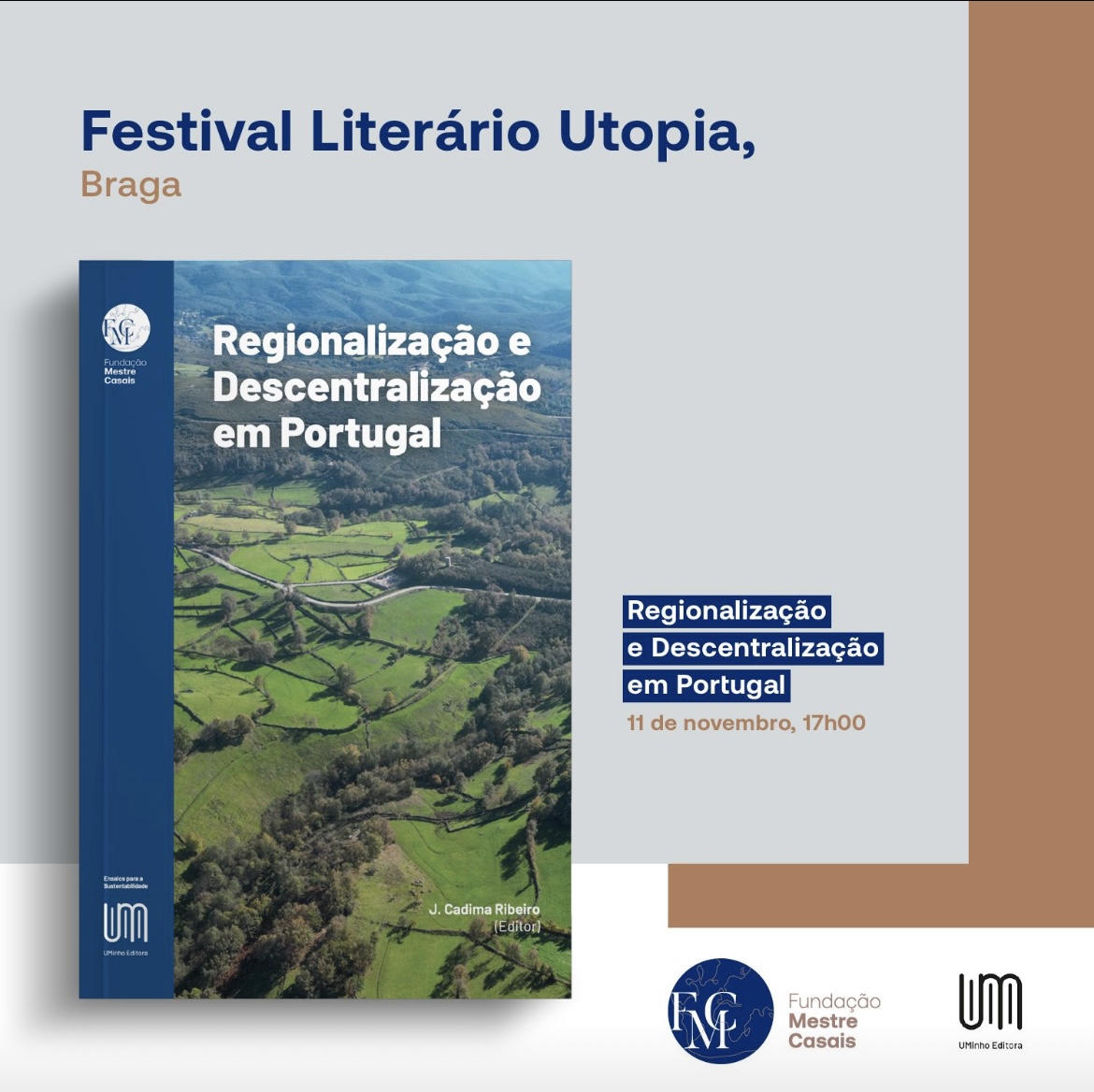
Relembra-se o próximo encontro integrado no Festival Literário Utopia, e renova-se convite aos interessados para participarem no evento.
Dia 11 de novembro, sábado, às 17h, na Casa do Conhecimento, Largo do Paço, Braga, a Fundação Mestre Casais e a UMinho Editora convidam para a apresentação de '𝗥𝗲𝗴𝗶𝗼𝗻𝗮𝗹𝗶𝘇𝗮𝗰̧𝗮̃𝗼 𝗲 𝗗𝗲𝘀𝗰𝗲𝗻𝘁𝗿𝗮𝗹𝗶𝘇𝗮𝗰̧𝗮̃𝗼 𝗲𝗺 𝗣𝗼𝗿𝘁𝘂𝗴𝗮𝗹', de José Cadima Ribeiro (ed.), com a presença do autor e de José Gomes Mendes, Presidente Executivo da Fundação.